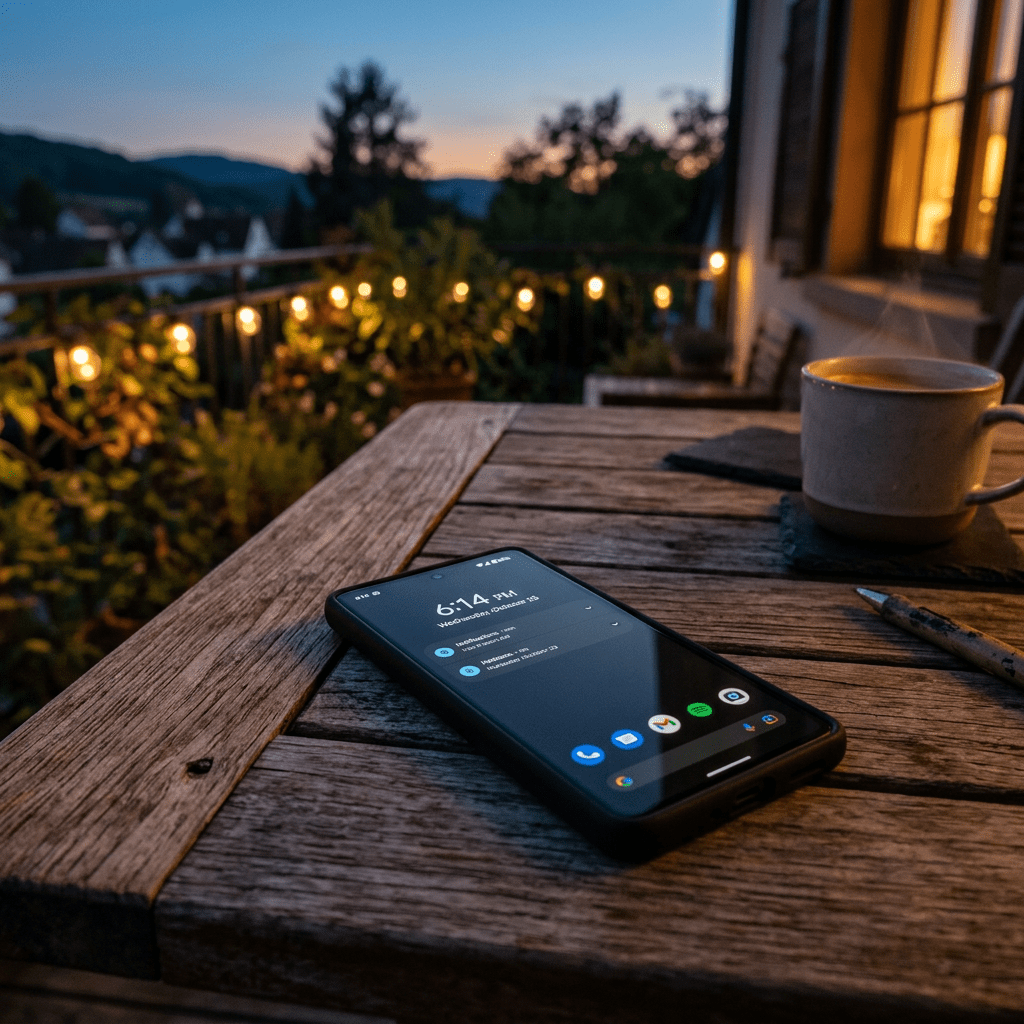
Your phone buzzes, and your stomach drops before you’ve even looked at it. You read a text at 11pm and feel obligated to answer it, even though you were already in bed, already off the clock, already done for the day. You send a message and then watch the little “read” indicator like it’s a verdict, and when twenty minutes pass without a reply, some part of you starts building a story about what that silence means.
None of this is a personality flaw. It’s a predictable response to living inside a communication system that was never designed with boundaries built in. Texting doesn’t come with office hours. It doesn’t come with an away message unless you build one yourself. And so, without ever agreeing to it, a lot of us have absorbed an unspoken rule: available means always available, and any gap in response time is something that needs explaining.
It’s time to question that rule out loud.
The Reframe: A Delayed Reply Is Not a Withheld Answer
Somewhere in the always-online era, response time quietly became a stand-in for how much someone cares. A fast reply reads as enthusiasm. A slow one reads as distance, disinterest, or worse. This equation feels intuitive, but it’s built on a shaky premise: that everyone’s nervous system, schedule, and relationship to their phone works the same way.
Here’s the reframe worth sitting with: the gap between a message being sent and a message being answered is not a message in itself. It’s just a gap, filled with whatever the other person happens to be doing with their actual life, most of which has nothing to do with you.
This matters because response-time anxiety doesn’t usually stay contained to individual moments. Left unchecked, it becomes a quiet, constant tax on your nervous system, checking your phone not because you want to, but because some part of you is on watch, scanning for the next data point to interpret. That’s not connection. That’s surveillance dressed up as closeness.
Why This Runs So Deep
Constant availability didn’t used to be possible, so it couldn’t be expected. A landline rang in one room of the house; if you weren’t there, that was simply the end of the story until later. Smartphones changed the physics of the situation without changing our expectations to match, we’re carrying a device that makes instant response possible, and somewhere along the way, possible quietly became assumed.
For a lot of people, the anxiety around response time also has older roots. If you grew up needing to closely monitor someone’s mood to feel safe, reading tone, watching for shifts, staying one step ahead of disappointment, a delayed reply can activate that same old alertness, even in a relationship that’s actually secure. Your phone becomes another surface to scan for the emotional information you learned, early, that you needed to track closely.
None of this means you’re needy or overly attached to your phone. It means you’re a person with a nervous system living inside a technology that was built for convenience, not for regulation, and nobody handed you a manual for how to use it without letting it use you back.
What This Habit Actually Costs You
It fragments your attention long after the message is answered. Even a brief check-in with your phone pulls a piece of your focus away from whatever you were actually doing, a conversation, a task, a moment with your kids, and that fragmentation adds up across a day in ways that are easy to underestimate.
It teaches the people around you that your time has no edges. If you reliably answer at all hours, you’re not just being helpful, you’re setting an expectation that will be difficult to walk back later. People learn your boundaries by watching what you actually do, not by what you’d prefer they assume.
It turns rest into something you have to defend. When “available” becomes the baseline, being unavailable starts to feel like it requires justification…. an out-of-office excuse, an apology, a reason. Rest shouldn’t need a permission slip.
What Healthy Digital Boundaries Actually Look Like
1. Separate urgency from importance. Most texts that feel urgent aren’t actually urgent, they just arrived in a format that creates urgency by default. Before reflexively responding, ask: does this need an answer in the next five minutes, or does it just feel that way because it’s sitting on my screen? Genuine emergencies are rare and usually come with a phone call, not a text.
2. Set your actual hours, and say them once instead of explaining every time. You don’t need to justify every delayed reply individually. A simple, standing boundary, stated once, to the people it matters for, does more work than a fresh explanation every time: “Heads up, I’m slow to reply most evenings, I’m not ignoring you.” Said once, it covers you for months.
3. Let read receipts and typing indicators lose their power. If they’re triggering a lot of anxiety, turning them off isn’t avoidance, it’s removing a source of data you don’t actually need in order to function. You don’t need real-time visibility into someone else’s process to trust the relationship.
4. Practice the pause before you reply out of urgency instead of intention. When you feel the reflex to answer immediately, pause and ask: am I responding because this matters to me right now, or because I feel a pull to close the open loop? Not every open loop needs closing the second it appears.
5. Model the boundary you want others to have with you. If you want people to feel comfortable taking their time responding to you, without spiraling about it, extend them that same grace visibly, don’t double-text within ten minutes, don’t read into a delay before you have reason to. Boundaries tend to travel in both directions once they’re modeled consistently.
The Question Worth Asking Yourself
Not “how fast should I be replying” …. there’s no universal right number, and chasing one just moves the anxiety around instead of resolving it.
The more useful question is: Am I checking my phone because I want to be present for this, or because I’m afraid of what a delay might mean?
If it’s the second one, that’s not a texting problem. That’s a nervous system asking for a little more safety than a read receipt can actually provide…. and that’s worth building, deliberately, off the smallest of screens.
Being reachable is not the same as being required. You’re allowed to have edges, even in a world that never logs off.




Leave a Reply